Play 6: Henry VI, Part III

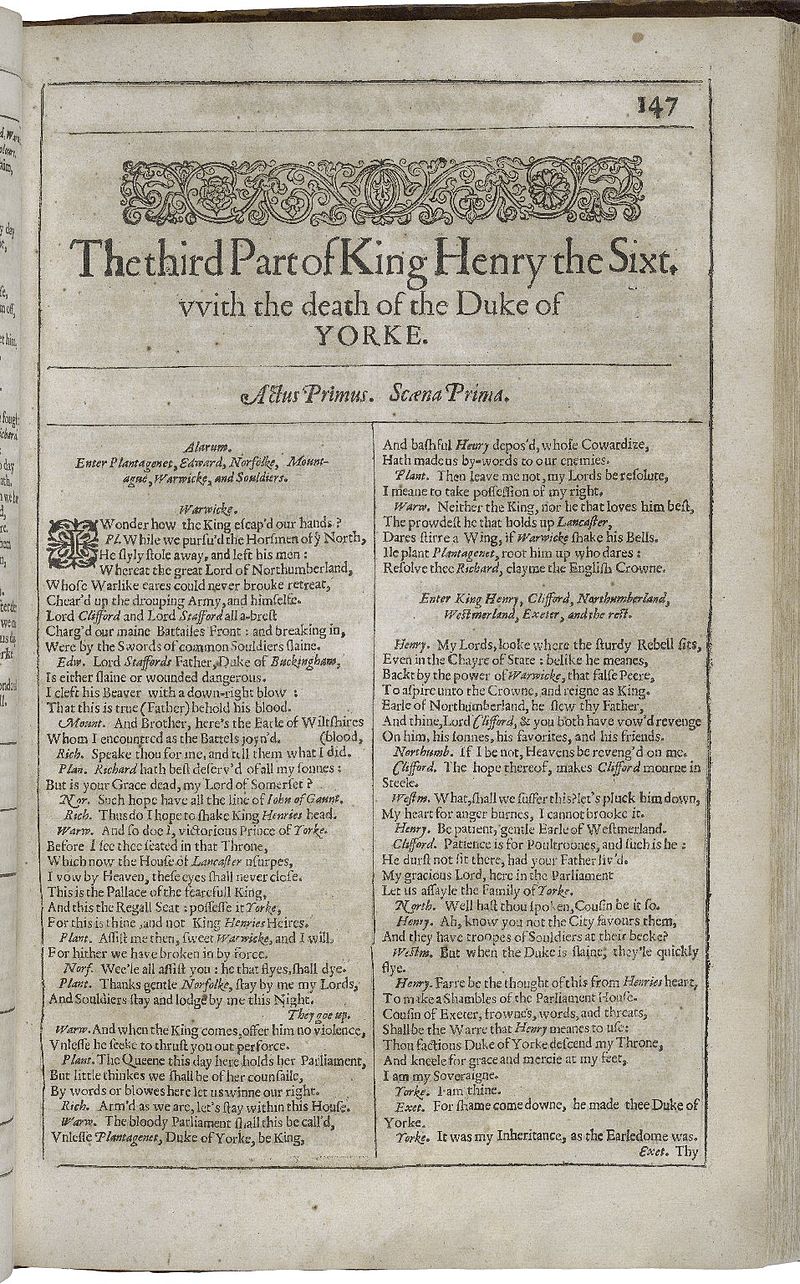
Henry VI, Part III first folio page.Moral Tales and Textual Pleasures

John Berryman hated Henry VI, Part III. He called it “the most tiresome play in the canon” in his 1958 essay (Berryman’s Shakespeare, 313). Harold Bloom finds the whole Henry VI trilogy to be among Shakespeare’s weakest. And W.H. Auden, in his Lectures on Shakespeare, called Part III “tedious” (9).

So, why were these plays so successful in the Elizabethan era? Why would audiences endure (and enjoy!) what even passionate modern Shakespeareans now dismiss? And why should you read these plays now?

Having struggled myself to find the pleasure in Henry VI, Part III at first, I’ve recognized (thanks to reading secondary material) that the chronicle plays require a different context for enjoyment than Shakespeare’s more psychological works. If Harold Bloom is right that Shakespeare “invented” the human, as we understand it today, then Shakespeare’s chronicle plays are a pageant of the “human” before Shakespeare’s re-invention of it. A modern audience member in the West must come to the Henry VI plays with the same open-mindedness that she brings to Noh theater. The chronicle plays are artifacts of a late medieval and early Renaissance psychology and value system that should not be assumed as part of common modern wisdom.

All together, the Henry VI plays depict the crowning and fall of a weak king, young Henry VI. And, alongside his reign, the plays trace the decay of the state into a chaos of warring factions and families. For an Elizabethan audience, the plays formed a moral tale of, on the one hand, the danger of a passive and overly pious sovereign (King Henry) and, on the other, the horror of a greedy and striving clan (the York clan, typified by Richard, Duke of Gloucester — later Richard III). The plays reinforce the necessity of a steady, powerful monarch and the importance of suppressing any contention of his/her leadership.

Looked at as a moral drama of a monarchical state, the chronicle plays, collectively, may have more in common with the allegorical medieval mystery plays than they do with Hamlet. The characters are not so often human beings as they are vehicles for the dramatization of moral situations. History is compressed (indeed Henry VI, Part III‘s events encompass a decade) to enable rapid juxtaposition of the warring perspectives — and to dramatize an accelerated decline.


HENRYS, EDWARDS, RICHARDS: THE ACTION

A lot happens in the five acts of Henry VI, Part III, with battles raging across England and the tide shifting throughout. One thing to keep straight: there are 2 each of Henrys, Edwards, and Richards — all of them important to the moral drama.

Henry VI is the titular center of the play but not much of a hero. His wife, Queen Margaret, is the warrior who fights on his behalf — the only engine striving to preserve the Lancaster line. He frets through much of the play about the quiet life he will never have, and he trades his succession to preserve the throne. His weakness is cowardice and a failure to assume his role. In the end, Richard, Duke of Gloucester kills him in London. Remember, Richard, Duke of Gloucester will become Richard III.

Henry, Earl of Richmond is the second Henry. He appears only briefly in the play, spirited to France to be kept secure. He’s there as a wink to the Elizabethan audience, for he will one day be crowned Henry VII, grandfather to Queen Elizabeth and founder of the Tudor dynasty. He is the picture of the perfect monarch: strong, regal. Henry VI acknowledges Richmond’s future in a brief reflection:

This pretty lad will prove our country’s bliss.
His looks are full of peaceful majesty,
His head by nature framed to wear a crown,
His hand to wield a scepter, and himself
Likely in time to bless a regal throne (IV.7, 70-4).

The first Edward, Edward Plantagenet, becomes (after his father’s death in the play), briefly, Edward, Duke of York and then King Edward IV. He’s the son of Richard, Duke of York, the duke who has been Henry VI’s bane through the first two plays. King Edward’s rule is marked by hubris and lust. He is morally corrupt — weak because a victim of his appetite. He makes an enemy of Warwick when, after sending Warwick to France to arrange Edward’s marriage to the French King’s daughter, Edward decides instead to marry Lady Grey (more on this below). He’s captured by Warwick, but at the end of the play he’s still the king .. with his brother, Richard, already plotting to overthrow him. Remember (again), Richard, Duke of Gloucester will become Richard III.

The second Edward is Henry VI’s son. Not much to know here. His father bargains all future Lancaster claim to the throne away to the Yorkists so that they will spare his, Henry VI’s, life. But to ensure that young Edward doesn’t try to make a comeback, Richard, Duke of Gloucester kills him … in front of Queen Margaret … his mom. Remember (yet again), Richard, Duke of Gloucester will become Richard III.

So, on to the Richards.

Richard, Duke of York, who has dreamed of restoring the York line to the throne from the first play in the cycle his killed early on in Henry VI, Part III by Queen Margaret. It’ll be up to his sons, Edward (soon King Edward IV) and …

Richard, Duke of Gloucester. Remember (from all of the above killing and plotting): Richard, Duke of Gloucester will one day be Richard III. But we only see the beginning of that campaign in Henry VI, Part III. In this play, Richard, Duke of Gloucester is the hammer who ensure the York line is secure in the throne (except for that pesky Henry, Earl of Richmond, who manages to escape). He kills Warwick. He kills Henry VI. He kills Henry’s son, Edward. And he defeats Queen Margaret and forces her to flee. With his brother on the throne, he’s already plotting King Edward’s overthrow at play’s end. He’s set up to be one of Shakespeare’s great anti-heroes.


THE PLEASURE OF THE TEXT

If I’m arguing that John Berryman and W.H. Auden may have missed the point in dismissing the play, then how is a modern audience supposed to enjoy Henry VI, Part III in this thick moral tale?

First, I will acknowledge that I don’t know that Berryman did miss the point. It would be hubris for me to make such a claim. He rightly points out the weakness in the poetry in several places, and he traces the fractured composition history that suggests Shakespeare’s perhaps limited involvement with whole acts (some argue that the play is a composite of works by several playwrights). I’ll admit my reading of the chronicles as morality plays may go too far as an excuse. While there is the intellectual satisfaction that comes from appreciating the play in its context, there are parts of the play that are a bit of a slog.

Second, Auden’s essay is more balanced than his claim of tedium implies (see the section on Richard below). The chronicles are not pure allegory. If you have patience with the moral narrative, there are moments of great textual pleasure of the typical Shakespearean kind to be found in Henry VI, Part III.

In fact, I’m astonished to find that none of the critics I’ve read remark about one of my favorite, bawdy Shakespeare exchanges. And this one comes at a critical moment in defining the character of King Edward.

Having just seized the throne and sent Warwick to France to negotiate a royal wedding with Lady Bona, sister of King Lewis, Edward lets his libido take him in a different direction.

Elizabeth Lady Grey arrives at court to plead for the lands of her deceased husband. King Edward, surveying the comely Lady Grey, suggests an “exchange,” one that the Lady is either too daft or too coy to hear at first.

LADY GREY
Why stops my lord? Shall I not hear my task?
KING EDWARD
Any easy task — ’tis but to love a king.
LADY GREY
That’s soon performed, because I am a subject.
KING EDWARD
Why, then, thy husband’s lands I freely give thee.
LADY GREY Curtsies.
I take my leave, with many thousand thanks.

….

KING EDWARD
But stay thee — ’tis the fruits of love I mean.
LADY GREY
The fruits of love I mean, my loving liege.
KING EDWARD
Ay, but I fear me in another sense.
What love think’st thou I sue so much to get?
LADY GREY
My love till death, my humble thanks, my prayers —
That love which virtue best and virtue grants.
KING EDWARD
No, by my troth, I did not mean such love (III.2, 52-64).

The humorous, naughty tension builds and the King is forced to spell out his bargain in crass terms.

KING EDWARD
To tell the plain, I aim to lie with thee.
LADY GREY
To tell you plain, I had rather lie in prison.

George Duke of Clarence says what doesn’t need to be said for comic effect: “He is the bluntest wooer in Christendom” (III.2, 83).

But Lady Grey is playing the Anne Boleyn game, it seems, using a feigned reluctance to bargain for a better offer, parrying the King’s efforts to get a too favorable contract.

KING EDWARD Aside
Her looks doth argue her replete with modesty;
Her words doth show her wit incomparable;
All her perfections challenge sovereignty.
One way or other, she is for a king;
And she shall be my love or else my queen.
To Lady Grey
Say that King Edward take thee for his queen?
LADY GREY
‘Tis better said than done, my gracious lord.
I am a subject fit to jest withal,
But far unfit to be a sovereign.
KING EDWARD
Sweet widow, by my state I swear thee
I speak no more than what my soul intends,
And that is to enjoy thee for my love.
LADY GREY
And that is more than I will yield unto.
I know I am too mean to be your queen,
And yet too good to be your concubine. [More wonderful bluntness]
KING EDWARD
You cavil, widow — I did mean my queen (III.2, 84-99).

Having played the game she gets her offer and seizes it –an event that catalyzes the near destruction of “lustful Edward” — as Richard refers to him (III.2, 129). We learn that Edward won’t be a good king or an honest king. But he will, apparently, be a very sexually satisfied king during his brief rule. That is, until an angry Warwick returns from France with an army, seeking Edward’s demise as payment for his whimsy in love.

So there is some textual fun in Henry VI, Part III.

And there is also some wonderful foreshadowing of the masterpiece Richard III.


THE RISE OF RICHARD

Alongside Auden’s critique of Henry VI, Part III, he identifies what he calls “Shakespeare’s first great soliloquy” by “Shakespeare’s first big character,” Richard Duke of Gloucester (yes, a reminder again that he will one day be Richard III) (Lectures 11-12). The passage comes just a few lines after Edward’s wooing of Lady Grey.

The soliloquy contains all the dark, murderous aspiration that makes Richard such an attractive and repulsive character at once. In this soliloquy Richard shows what is missing from the weak and weak-willed cipher-kings of the Henry VI plays — a striving “modern” anti-hero with an interior life. It is a fitting place to end this reflection on what Henry VI, Part III has to offer.

And I — like one lost in a thorny wood,
That rends the thorns and is rent with the thorns,
Seeking a way and straying from the way,
Not knowing how to find the open air,
But toiling desperately to find it out —
Torment myself to catch the English crown.
And from that torment I will free myself.
Or hew my way out with a bloody ax.
Why, I can smile, and murder whiles I smile,
And cry “Content!” to that which grieves my heart,
And wet my cheeks with artificial tears,
And frame my face to all occasions.
I’ll drown more sailors than he mermaid shall;
I’ll slay more gazers than the basilisk;
I’ll play the orator as well as Nestor,
Deceive more slyly than Ulysses could,
And, like Sinon, take another Troy.
I can add colors to the chameleon,
Change shapes with Proteus for advantages,
And set the murderous Machiavel to school.
Can I do this, and cannot get a crown?
Tut, were it farther off, I’ll pluck it down (III.2, 174-95).



July 2015: Reading Henry VI, Part III

Darragh Kennan as Iago in Seattle Shakespeare Company's "Othello"

Darragh Kennan as Iago in SSC’s Othello

If you are following along at home with shakespeareyear.com, we’ll be reading Henry VI, Part III for July 2015. You don’t have to read Parts I and II to appreciate Henry VI, Part III, but some familiarity with the plots and characters of those plays will certainly help.

As a primer, you can check out these shakespeareyear.com posts:

Through the month, I’ll post information about (or related to) the play. And by the end of the month, I’ll post my own notes about my experience reading the play.

Feel free to add your comments to this post. Let me know what you think!

As an aside: I recently saw a wonderful production of Othello by the Seattle Shakespeare Company to end the 2014-15 season. Darragh Kennan (pictured), one of my favorite Shakespearean actors, played Iago.  I’m looking forward the summer outdoor Shakespeare season that starts this month.

Shakespeare for Poem in Your Pocket Day

Each April since 1996, The Academy of American Poets has helped raise the visibility of poetry in American culture through the celebration of Poetry Month. And today, on the final day of April, The Academy encourages poetry lovers to especially celebrate with “poem in your pocket day.” The idea: you print out a poem and walk around with it in your pocket all day, sharing it with friends and strangers alike.

Here’s my Shakespeare in my pocket for today. “Orpheus” is a song from Henry the VIII, and I once performed (though I can’t find the composer of the particular version I sang; there have been many versions over the years!).

Orpheus

Orpheus with his lute made trees
And the mountain tops that freeze
Bow themselves when he did sing:
To his music plants and flowers
Ever sprung; as sun and showers
There had made a lasting spring.

Every thing that heard him play,
Even the billows of the sea,
Hung their heads and then lay by.
In sweet music is such art,
Killing care and grief of heart
Fall asleep, or hearing, die.

From poets.org.

Play 5: Henry VI, Part II

Much Ado About Hawking

I’ve been stuck on Henry VI, Part II. I’ve not been stuck on reading. I actually finished reading the play (and its successor) a few months ago. I’ve been stuck writing about it. What to say? It’s a middle play that was written first. As noted in my short essay on Part I, that play was written last — critics believe — to round out the cycle. It was written to play on the audience’s knowledge of things to come.

The problem is, not much develops in any normal, literary sense in Part II. Part III has the big pay off: the killing of King Henry, the rise of the York line, Richard III’s seizure of power. Part II, on the other hand, contents itself with murmurs and intimations of bad stuff to come.

HAWKS AND DOVES
So, what does happen in Henry VI, Part II? Birds. There’s an abundance (a weird, deliberate-feeling abundance) of animal imagery in the play, but on re-reading, I found it was the bird images that most stood out. This is a play about machinations to seize power, and if there is a single picture that captures of the feeling of the play, it that of birds of prey circling victims from 300 feet up. The “hawks and falcons” are the York clan and also Queen Margaret and Somerset. And the prey is King Henry. Before Richard Duke of York (the father of Richard III) or Edward can seize power, they (and, with different objectives) Queen Margaret pick apart he King’s helpless “flock.”

In Act I, Queen Margaret chooses her first target: the wife of Gloucester, the Lord Protector’s spouse. Margaret is (rightly) troubled by the Duchess of Gloucester’s ambitions. Suffolk announces:

Madam, myself have limed a bush for her,
And placed a choir of such enticing birds
That she will light to listen in their lays,
And never mount to trouble you again (I.3, 91-4).

“Liming” a bush was the Elizabethan method of putting lime onto branches and twigs to catch birds, it turns out.

But the tactics of trapping the Gloucesters are more subtle than simple hunting them straight. At the start of Act II, while the royal retinue actually indulges in a bit of recreational falconry, the Iago-like Suffolk seizes the symbol-rich moment to intimate to the King that Gloucester is the hawk who seeks the crown:

My Lord Protector’s hawks do tower so well;
They know their master loves to be aloft,
And bears his thoughts above his falcon’s pitch (II.1, 10-2).

The Penguin edition reminds readers that the heraldic badge of the Gloucesters was hawk with a maiden head, so Suffolk is preying on a ready analogy. But, as audience members know from watching Gloucester’s angry confrontations with his over-eager wife, he actually is more of a dove than a hawk. The Duchess, a hawk herself, recognizes the predatory traps (as she herself is about to be exiled), warning her husband:

…be thou mild and blush not at my shame,
Nor stir at nothing till the ax of death
Hang over thee, as sure it shortly will.
For Suffolk, he that can do all in all
With her [Queen Margaret] that hateth thee and hates us all,
And York, and impious Beaufort that false priest,
Have all limed bushes to betray thy wings,
And fly though how thou canst, they’ll tangle thee.
But fear not thou until thy foot be snared,
Nor never seek prevention of thy foes. (II.4, 49-58).

Gloucester, the naïve bird that he is, believes his blameless, bird-of-the-field heart will keep him safe. He’s wrong. He’s smothered in his bead (one must presume a feather bed) to kick off Act III, scene 2.

The King shows he is no bird-brain. Or, rather he shows–being convinced that Suffolk is the cause of Gloucester’s death–that he can be the falconer who recalls the raptor:

What, doth my Lord of Suffolk comfort me?
Came he right now to sing a raven’s note
Whose dismal tune bereft my vital powers;
And thinks he that the chirping of a wren,
By crying comfort from a hollow breast
Can chase away the first-conceived sound?
Hide not thy poison with such sugared words (III.2, 39-45).

Suffolk is banished, pushed out of the royal nest — which all comes a bit late for Gloucester, who remains dead for the rest of the play.

Why such flocks of bird imagery in a history play? The images of falconry and liming, I believe, offered Shakespeare a ready set of analogies for the this play of slowly unfolding strategies and circling power-seekers. But they also add music to a play that otherwise lacks some of the fuel (content-wise) of Part III or some of the earlier plays. Without the blood of Titus or the wit of Taming of the Shrew or the scheming of Richard III (in Part III), Shakespeare added poetry, delicately weaving avian themes into a courtly history.

THE TWO TOWERS
I can’t leave aside Henry VI, Part II without talking about the Tower. As a silly American, I had always associated the phrase, “The Tower of London” with imprisonment, torture, and beheading. But on a trip to London this past summer, I was embarrassed to learn its real history as the seat of the English monarchy for centuries. Turns out Kings of England liked to keep their enemies close to home. So, the Tower was both a prison and a palace.

In the Henry VI plays, as the hawks begin to circle the pious king, the Tower does start to feel like a cage, even for the king. I had a visceral sense of the palace-is-my-prison dichotomy while touring the Tower myself. The resident beefeaters recounted the Cade rebellion even as I was reading the play depicting it. While the rebellion seems a dumbshow as depicted in the play (most famous, perhaps, for the Butcher’s line: “The first think we do let’s kill all the lawyers” (IV.2, 81)), seeing how close the rebels actually came to taking the Tower (London Bridge is just one Starbucks away!) makes it seem as though it were a much more serious affair.

In the end, though, the rebellion is put down. With my 21st-century eye on the play, I feel like that’s the part I’d cut if I were making the Henry VI movie. It’s an interesting diversion that goes nowhere.

The real matter at the end of the play is the Richards. In Act V, Richard III, “crookback Richard,” makes his first appearance. Richard Duke of York kills Clifford. And the War of the Roses truly commences. Henry, Margaret, and Young Clifford are forced to flee.

York has won the battle but not yet the war. On to Part III.

Play 4: Henry VI, Part I

King_Henry_VI I was caught off guard by Henry VI, Part I. I wasn’t prepared, I now realize, for a history play about a history of which I knew little. The Henry VI plays (three in the cycle) are rich and complex with massive cast lists. They presuppose a subtle knowledge of the unsteady relationships among the characters — their long-standing grudges and hatreds. The plays expect the audience to gasp when the youthful versions of later heroes and villains take the stage.

Though my education steeped me in Elizabethan literature and history, the War of the Roses was always just glimpsed. The three plays in the Henry VI cycles are Shakespeare’s rendering of that War, a rendering that is not an accurate history (of course), but a literary history filtered through his present that conjoins key moments spread across several decades. Part I, which is believed to have been written after Parts II and III, feels like a proper prequel. Marjorie Garber even calls it one. The Tudor audiences must have smiled to each other knowingly when the houses of York and Lancaster begin bickering and calling out “teams” by passing out white and red roses. With events occurring 150 years before Shakespeare’s time, the War of the Roses was about as distant from Shakespeare as the Civil War is from us, but the resolution was only one king away (it was Henry VII who unified York and Lancaster in the Tudor dynasty).

Harold Bloom has referred to literature as a “difficult pleasure.” The Henry IV cycle is just such a rewarding, difficult set of plays. If you haven’t read them, I encourage you to devote the time after first reading a bit (not too much is required) about Britain in the 1400s.

Somehow, I didn’t have the same trouble wrapping my brain around Henry V. Of course, my first experience of that play was a film — Kenneth Branagh’s adaptation. It also has an arc — culminating in the Battle of Agincourt — that fits filmic models for storytelling: a young king proves himself in a series of conflicts. He gives a rousing speech to his troops. He wins. He gets the girl.

The Henry VI plays offer no such simple summary. They are truly of the form of history — chaotic, emotionally shifting without a strong beginning, middle, and end. But the lack of a traditional arc is not a reason to dismiss the plays. I found them the most enjoyable when I put away my expectations for how a story should be told and just let the action wash over me.

An aside: Thanks goes to my friend Mike Mikesell, who has joined me in reading Shakespeare. We’ve discussed these plays at length, and it has made it even more enjoyable to share our thoughts as we journeyed from confusion to surprise and delight.

A PLAY OF PORTENTS
As the Henry VI opens, Bedford, Exeter, Gloucester, and Winchester gather to mourn the death of Henry V. They also learn that the great hero of the French wars, Talbot, has been taken prisoner. Bedford gathers 10,000 men to free Talbot, which he does successfully, only to watch Talbot defeated (not killed, though) in single combat with Joan de Pucelle (a.k.a. St. Joan of Arc).

Talbot and Joan — not Henry VI — are the action stars of this prequel. What is dramatized is the closing days (years?) of Britain’s victories in France. Led by Talbot, the English soldiers rally to retake cities won by Joan. Joan takes Orleans. Talbot takes Orleans. Joan takes Rouen. Talbot takes Rouen back the next day. But Talbot’s string of victories ends in battlefields outside of Bordeaux. He and his son are slaughtered when the bickering British nobles fail to send him the reinforcements he so desperately needs.

And it is this bickering — not the battling — that is the center of the play … and the cycle of Henry VI plays.

Henry VI, Part 1 has some kinship with Star Wars, Episode 1: The Phantom Menace : much of the delight comes from knowing what the drama portents for historically later tales that have already been enacted. In the play, it is the nascent conflict between the Lancasters and the Yorkists that replaces the “Star Wars” between the Rebel Alliance and the Empire. Not much blood will be shed in Henry VI, Part 1 , but if you know how it all ends up, nearly every scene crackles with some importance for the future narrative.

The crux is spelled out in Act II in The Temple garden in London in a gathering of young British aristocrats. Years ago, they all recall, Richard, Earl of Cambridge, was executed for treason. Somerset (on the Lancaster side) asserts that this act of treason voids Richard (son of the Earl) Plantagenet’s claim to the throne. Warwick (on the York side) observes that Richard Plantagenet’s grandfather, Lionel, Duke of Clarence, was the third son of King Edward III — making Richard Plantagenet a rightful heir to the throne, even if he is descended from a failed usurper.

Richard Plantagenet asks the nobles who have gathered each to take up a flower to demonstrate their feelings on the matter. Those who support him, he avers, should take up a white rose. Meanwhile, Somerset offers the red for those who support King Henry VI’s claim. It all seems very legalistic and silly.

A PLAYWRIGHT’S POLITICAL HIGH-WIRE ACT
Shakespeare’s audience must have trembled (in nervous pleasure) witnessing the dangerous flower exchange moment — a fictionalized inception for the War of the Roses (complete with the plucking of the colored flowers).

It must have felt a bit daring to hear such frank talk about the complicated justifications for kingship. Imagine a modern Russian playwright living in Moscow and composing a popular play, playing in sight of the Kremlin, that dramatizes the conflicts, back-stabbing, murder, and deceit among Vladimir Putin’s government ministers — or those of Putin’s great-grandfather, at least.

In some ways, that was the situation of Shakespeare’s writing War of the Roses plays, narrating The Temple garden debate. Remember, people were being put to death or imprisoned in the Tower for suggesting mildly treasonous ideas. It was all history, sure. But the portents in the play directly point to the Tudor family.

The legalistic debate soon has bloody consequences. In the play, York and Somerset pull their support for the embattled Talbot and leave him to die. But that is just the start. Years of war would follow. Amazing that Shakespeare had the audacity to take all of this on.

IT’S NOT GOOD TO BE A WEAK KING
Implicit in this play and the others in the cycle, is that it is the weakness and blindness of Henry VI (his kindness and holiness) that enables the debates to turn to blood. He calls the jousting over roses “slight and frivolous” (IV.1 112). He espouses good Christian values but seems to lack the vigor of his soldier-king father that would quell dissent. In Act III, overhearing the contention, he makes one of several of his limp pleas for peace:

Uncles of Gloucester and of Winchester,
The special watchmen of our English weal,
I would prevail, if prayers might prevail,
To join you hearts in love and amity.
O what a scandal is it to our crown
That two such noble peers as ye should jar!
Believe me, lords, my tender years can tell
Civil dissension is a viperous worm
That gnaws the bowels of the commonwealth (III.1, 66-74).

“Oh,” the Elizabethan audience must have moaned, “Get a clue, Henry!”

Were the historic outcome different, these may have seemed noble words. But, as the play ends, the aristocrats are drawing up internal fronts while British power in France wanes. We, as readers or theater-goers, know that Richard is going to install his son on the throne eventually and that Margaret, Henry’s future Queen, will seize power for a time, too.

And other power plays are in the making.

In the closing, Suffolk woos Queen Margaret for King Henry, and, in an aside, declares that it is he, Suffolk, who will rule them both:

Margaret shall now be queen and rule the king;
But I will rule both her, the king, and the realm (V.7, 107-8).

At the play’s end, the bickering has remained nothing but words in Henry VI, Part 1 (except for Talbot’s death, of course). The tragic course of history is laid bare, piece by piece.

Of all of the play portents, none is greater than the one repeated by Exeter:

And now I fear the fatal prophecy
Which, in the time of Henry named the Fifth,
Was in the mouth of every sucking babe:
That “Henry born of Monmouth should win all,
And Henry born at Windsor should lose all” —
Which is so plain that Exeter doth wish
His days may finish, ere that hapless time (III.1, 199-205).

SHAKESPEARE?
The play was first printed in the 1623 First Folio, and some question whether it was, in fact, written by Shakespeare. The Oxford Shakespeare notes that only parts of Act II and Act IV can be “confidently attributed to Shakespeare.”

I find all of this debate absurd.

When you contemplate the achievement — the audacity of writing a play that is so taunting, that takes on the tenuous justification for a monarch’s rule and the conflicts among the family members who were the forebears of the SITTING QUEEN; a play that establishes a multi-part history arc while remaining its own whole work of art (the first part of one of the first trilogies); a play that is fueled almost entirely with portents of what is to come, with unresolved tensions and the ignition of conflicts that will be developed across two tetralogies — you can’t help but smile and know that an incredible talent was behind this.

CODA: JOAN OF ARC (TURNS OUT SHE’S A WITCH, NOT A SAINT)
I can’t put aside this play without a few words regarding Joan la Pucelle. As noted above, Joan la Pucelle (Joan of Arc) is a major character in the play. How did I not know that Shakespeare had written a play with “St. Joan” at its center?

If you are familiar with Joan of Arc from any modern films or plays … that Joan is not Shakespeare’s Joan. She’s a force, to be sure. She defeats Charles (the dauphin of France) in single combat and then battles Talbot — the greatest English soldier — to a standstill. She scowls at the incompetence of some of her fellow French soldiers, and she even incites (“bewitches”) Burgundy’s conversion to the French cause.

As a character, she’s surprising and fascinating — if a bit shallow — for most of the play. She is legitimately a powerful, unapologetic warrior woman. Sure, some of this may be a sideways critique of the masculinity of the French army, but she stands out among the meek, non-warlike women of all of Shakespeare’s plays thus far.

Unsurprisingly, though, Shakespeare can’t leave his bizarre, powerful French creation alone. After four acts of literary disruption and estrangement for all conventions of female characters, Joan becomes something else in the fifth. In scene three of act five, a scene that could easily have been lifted from the play with no ripples across the rest of the action, Joan summons creatures from hell and alludes to her third nipple — the nipple of blood that was conventionally used by witches to suckle demons. The demons refuse to join her cause, and she laments:

My ancient incantations are too weak,
And hell too strong for me to buckle with.
Now, France, thy glory droopeth to dust (v.3, 27-29).

So, we’re to dismiss all that has come before, it seems. All Joan’s success, this says, was not (as has been French convention) to be credited to divine inspiration of a saintly hero. No, Joan is a demon-conjuring witch.

But the rapid moral destruction of this interesting character descends even further three scenes later when, after Joan is captured by York, she lets tumble a flurry of self-serving lies:

  • She denies that her father is a lowly shepherd.
  • She claims noble birth.
  • She claims she is a “maid,” Joan of Arc, “Chaste and immaculate in very thought” (v.6, 51).
  • Then, in a final panic, she claims to be with child, hoping pregnancy will stay her execution.

I am with child, ye bloody homicides.
Murder not then the fruit within my womb,
Although ye hale me to violent death (v.6, 62-4).

The dialogue drops to hilarity as she declares in sequence, testing the English the response, that the father of the child is Duke Alencon and then Rene King of Naples. After this fruitless exercise, she spits out some final vitriol (“break your necks and hang yourselves” (v.6, 91)) before being yanked off stage, condemned to burn.

It’s sacrilege, I know, to play “what if” with Shakespeare, to want his plays to have modern sensibilities. And I would know the danger of Bowdlerization — even for socially just causes. But I would have loved to see what Shakespeare would have done with a character like Joan had he not faced the trouble of putting a French female hero in the middle of his play. She’s pretty interesting in the first four acts.

Cheat Sheet: English Kings in Shakespeare’s History Plays

While I have a serviceable knowledge of Elizabethan history, as I started in on the “Henry VI” trilogy, I realized that I was woefully underprepared to read, understand, and write about the Plantagenet dynasty. This led me to step back and fill in some gaps in my history education. Re-reading Henry VI, Part 1 now, with this historical context has given me a much greater appreciation for the massive achievement that is Shakespeare’s history plays. They tell a complex, interlocking story of power struggles across generations. And they do it all while dramatizing usurpation without glorifying it in the plays’ actions (an act that might have earned a banned play or a severed head); they interrogate the rise of Tudor power without raising concerns about legitimacy. The plays are a thrilling dance across history and British politics.

I’m sketching these notes in now as I prepare to write about the Henry VI cycle. I’ll return to these notes and likely fill them in as I get further in the project. Dates are courtesy of our friends at Wikipedia.

Henry II

Ruled: 1154–1189
No play
Henry II was the patriarch of the Plantagenet line.

Richard I

Ruled: 1189–1199
No play
Richard is known as “the Lionhearted” and was father of Philip, “The Bastard” in the play, King John.

King John

Ruled: 1189–1199
Play: 1596

Henry III

Ruled: 1216–1272
No play.
Henry III surfaces as “Prince Henry” in the play, King John .

Edward I

Ruled: 1272–1307
No play

Edward II

Ruled: 1307–1327
No play

Edward III

Ruled: 1327–1377
No play

Richard II

Ruled: 1377–1399
Play: 1595

Henry IV

Ruled: 1399–1413
Plays:

  • Henry IV, Part 1 (1596–1597)
  • Henry IV, Part 2 (1596–1597)

Henry IV’s father was John of Gaunt, Duke of Lancaster. Henry IV seized the throne from his cousin Richard (of the York line) in 1399. This Lancaster/York conflict that resulted from this usurpation would serve as the basis for the War of the Roses.

Henry V

Ruled: 1413–1422
Play: 1598–1599
The play dramatizes the story of Henry V’s maturing as a leader and his victory over the French at Agincourt. The play has little of the court intrigue that features in the other history plays.

Henry VI

Ruled: 1422–1461, 1470-71
Plays:

  • Henry VI, Part 1 (1591): This play dramatizes the ignition of the War of the Roses
  • Henry VI, Part 2 (1590-1591)
  • Henry VI, Part 3 (1591)

Edward IV

Ruled: 1461–1470, 1471-1483
No play.
Edward IV was son of Richard, Duke of York (aka Richard Plantagenet) of the Henry VI cycle. He seized power twice, losing it the first time back to Henry VI. He died suddenly, leaving a young son powerless to hold together the fragile York rule.

Edward V

Ruled: 1483
No play
Edward V was, as a child, king for only a few months before being imprisoned (and probably murdered) in the Tower of London by the “Lord Protector,” Richard, who would become Richard III.

Richard III

Ruled: 1483–1485
Play: 1592

Henry VII

Ruled: 1485–1509
No play
Henry VII seized the throne from the hated Richard III at the Battle of Bosworth. He then married Elizabeth, daughter of Edward IV, to unify the houses of York and Lancaster. Henry VII was thus the patriarch of the Tudor line and marks the end of the Plantagenet line. The Tudor symbol, the white rose within the red, symbolizes this union.

Henry VIII

Ruled: 1509–1547
Play (Henry VIII, or All is True): 1613

Play 3: Titus Andronicus

It is fitting that I’m writing about Titus Andronicus during the week of Halloween. It is the bloodiest, most horrific of any of the Shakespeare plays I’ve read in my life (and that includes Macbeth and Hamlet, both of which are Halloween-worthy with their gore, ghosts, and witches). But I thoroughly enjoyed it, especially with the companion of Julie Taymor’s Titus (1999), which stars Anthony Hopkins and Jessica Lange.

Aside: You’ll also notice, if you are looking at my reading plan for the year, I’m now about 3 weeks behind schedule. I’ll need to catch up over holiday breaks, but this project is also forcing me to confront my choice about how I spend my free time. In the balance, I’m finding the time spent reading Shakespeare feels far more rewarding (and enjoyable!) than the time I spent in the last week playing Grand Theft Auto 5. That isn’t a critique of the game–though I’ve not been a fan of the franchise (personal taste); rather, I’m finding that spending time with Shakespeare really is a pleasure. And for those of you who might leap to critique GTA5 for all the things you may have read and hear about it, I assure you that Titus Andronicus is far more violent.

THE PLOT: BODY COUNT
Unless you are reading along or have seen Taymor’s movie, I expect you haven’t read this play. It isn’t produced often, and I had heard very little about it before it came up on my list. So I’ll provide a short synopsis. It is worth noting, first, if you’ve haven’t seen the play that Taymor’s movie makes a number of changes to the sequence of the scenes and, importantly, dramatizes a long-standing love between Lavinia and Bassianus (all with non-verbal cues) that is not as present in the actual text.

The play begins after the death of the Roman Emperor. The Emperor’s two sons, Saturninus (the older) and Bassiunus, are vying for the throne. When general Titus Andronicus returns from the Goth wars, some of the Roman public urge him to seize the empire. Titus, wearied by war and the death of 25 sons (only four remain alive) refuses the throne and backs Saturninus. At the same time, despite the pleadings of the Goth queen, Tamora, he publicly executes her son, Alarbus (26), to appease the gods. The killing is the trigger for most of the tragedy that will follow.

Titus offers his daughter, Lavinia, to Saturninus to become the Empress. But within a page of the text, Saturninus throws her over and decides to wed Tamora. Luckily for Lavinia (or, unluckily, as it will soon turn out), Bassianus is in love with her and the two flee. Mutius (27), one of Titus’ four remaining sons, defends her departure. For that, Titus kills him.

Meanwhile, Tamora is already plotting to make Saturninus a cuckold by way of the Moor, Aaron. And she goads her sons to rape Lavinia and kill Bassianus. She’s so brilliantly constructed the plot that Titus’ own sons, Quintus and Martius, are accused of the murder and are ordered to be executed.

Now the blood really flows.

Lavinia stumbles across the stage after her rape. Her hands are cut off and her tongue is cut out — a ploy by Tamora’s sons, Demetrius and Chiron, to keep her from communicating the perpetrators.

The distraught Titus, now flailing in emotional agony, is tricked by Aaron to cut off his own hand as a tribute to the Emperor as a way to save his sons’ lives. But the severed hand is quickly returned to Titus — along with the heads of Quintus and Martius.

It appears as if Titus has gone mad for a time, and he pleads with the gods for justice. But, in the end, he undertakes one last, great war: he has his son Lucius align with the Goths for an invasion of Rome.

On the eve of battle, Titus successfully plots the deaths of the rapists, Demetrius and Chiron, and of Tamora and Saturninus. Indeed, he feeds Demetrius and Chiron (baked in a pie) to their mother before he kills her. He also kills his daughter, and he is murdered himself in the final triangle of death with the Emperor and Empress.

Oh, and along the way Aaron announces that the Empress, Tamora, bore him a son — one that he has saved from the execution she ordered.

In summary, I will forever remember Titus Andronicus as the play of severed heads, hands, and tongues; of rape and cannibalism; and of threatened infanticide. Not light fare.

Marjorie Garber offers the reminder that in the 1500s, public execution was still a major form of entertainment. So maybe the play was just another night out for the average Elizabethan.

ROMAN STOICISM AND GOTHIC BLOOD
Titus Andronicus offers me an opportunity to write about Roman stoicism for a bit, or the lack of it. Several years ago, reading Marcus Aurelius was, for me, a strange return to the glories of Western cultural studies. Long a student of Zen, I was struck by the resemblance between Aurelius’ world view and that of Dogen. Somehow, these people living in murderous times found a path to calm, a path to a kind of fatalism that did not turn into nihilism. Aurelius bridged my reading of Eastern philosophy and my knowledge of classical literature. He showed me Zen roots within the Roman tradition.

Titus is not a Roman stoic in the form of Marcus Aurelius. At first, I thought he might be. He starts that way, certainly, with a triumphant yet humble return to Rome and the calculated decision to execute Tamora’s son — in the face of her pleading — as a necessary sacrifice (by Roman terms).

But his stoicism turns to something chilling when he kills his own son, Mutius, when Mutius helps Lavinia escape with Bassianus. How is this necessary?

Titus unwinds when he discovers Lavinia raped and mutilated and two of his remaining sons accused of murdering Bassianus. Briefly, it seems as though he will become a raving Lear.

Then Titus returns to a kind of stoic center (or is it?) and uses feigned madness to trap and kill Demetrius, Chiron, Tamora, and Saturninus. Their deaths position Lucius to rule. Was that Titus’ plan all along? There is something both horrifying and enjoyable in watching Titus’ vengeful self-mastery as his plot comes together.

But Lavinia’s death remains an oddity that belies the stoic reading.

TITUS
…Was it well done of rash Virginius
To slay his daughter with his own right hand,
Because she was enforced, stained, and deflowered?
SATURNINUS
It was, Andronicus.
TITUS
Your reason, might lord?
SATURNINUS
Because the girl should not survive her shame,
And by her presence still renew his sorrows.
TITUS
A reason mighty, strong, and effectual;
A pattern, precedent, and lively warrant
For me, most wretched, to perform the like.
Die, die, Lavinia, and thy shame with thee,
And with thy shame thy father’s sorrow die!
[He kills her.] (V.3, 36-47).

Is this his full embodiment of his role as madman, part of a stoic’s plot to set order? Or is Lavinia’s death — and his own 16 lines later — a colossal failure of this self-mastery, of his stoicism in the face of grief?

Garber sees Lucius’ ascension as a restoration of order. But this is how I end up reading Titus Andronicus: not as a tragedy in the spirit of Shakespeare’s later tragedies but as a play of blood and horror that flows from the loss of Roman stoicism, a loss of order and self-control.

Harold Bloom goes so far as to say Shakespeare was exorcising Marlowe with the play. Certainly, the play is more like Marlowe, more vicious, than anything else of Shakespeare’s I’ve read. As with much Marlowe, the hero is at the center of the sea of blood. For me, Titus becomes a mirror of Tamora and Aaron. The glory of the Roman general falls away as he becomes an emotional, vengeful wreck, a sociopathic man-child who kills his own children.

Lucius may replace him and Saturninus as the figurehead of Rome. But I don’t see that Lucius has set a new course. Shakespeare chose to end the play not with harmony, not with “Lucius, all hail, Rome’s gracious governor!” (V.3 146) but with more vitriol — now from Lucius himself:

As for that ravenous tiger, Tamora,
No funeral rite, nor man in mourning weeds,
No mournful bell shall ring her burial;
But throw her forth to beasts and birds to prey.
Her life was beastly and devoid of pity,
And being dead, let birds on her take pity! (V.3, 195-200).

Tamora is beastly? Devoid of pity? Are the Andronici different? Isn’t Lucius describing his father?

Play 2: The Taming of the Shrew

Wow. It took me almost a month to get my thoughts collected and written for the second play — not as fast as I had hoped. It has been a very busy several weeks, as I had expected (that’s why I assigned myself three plays for September). I’m already reading Titus Andronicus, but it has been difficult to get the writing done with the school year starting and long days at Bungie. Also, it was a challenge for me with this play, Taming of the Shrew, to find a way to talk about its gender politics while also celebrating its sharp comedy of identity. So I just chopped my thoughts in two.

SHAKESPEARE, MISOGYNIST?

I didn’t start this project to dwell on Shakespeare with a polemical, political filter. But it is hard not to open with gender politics when you’re talking about The Taming of the Shrew in the Twenty-first century. Sitting down to write this, I just came off of watching Milk, the Sean Penn biopic about San Francisco gay rights advocate Harvey Milk. The presence of that film in my mind inclined me want to be harsher with Shakespeare than I was right after putting The Taming of the Shrew down.

In blunt terms, the plot (abstracted from the humor and elegant absurdity that makes it worth reading) sounds like a right-wing dystopian novel about women, akin to Margaret Atwood’s Handmaiden’s Tale. Baptista Minola of Padua is father to Kate and Bianca. Bianca is young, passive, and beautiful. Kate is, by the terms of the play, a “shrew” — a woman whose opinions won’t be tamed. Bianca has many suitors, notably Hortensio; the student, Lucentio (newly arrived from Pisa); and the pantaloon, Gremio. But before Baptista will allow Bianca to marry, he insists that Kate find a husband. He cloisters away Bianca, restricting her only to her tutors until Kate’s wedding day. Just in time, Petruchio arrives in Padua, enticed by the challenge of taming Kate, marrying her, and capturing her dowry. He undertakes a campaign of deprivation and distortion to break her. He insists that good food tastes terrible and that her accommodations are too poor for her to sleep, and he won’t concede until she obeys his every command. In the end, exhausted and famished, she does break and agrees to marry Petruchio. Lucentio, who — along with Hortensio — has managed to court Bianca by posing as a tutor, wins Bianca’s hand. But Petruchio “wins” the day with a final demonstration of Kate’s obedience: she comes when called and does his bidding without question while the other husbands look on with awe.

Marjorie Garber’s approach to The Taming of the Shrew tempers my snide, Twenty-first Century summary. She points out that, while the play is certainly “of its time” in its depiction of women, Shakespeare is always polyphonic in his work. Indeed, Kate is a fabulously strong character — after some stilted early moments, and I buy Garber’s argument that a talented actress can perform a completely ironic reading of Kate, and even her famed last speech (try it yourself, reading the whole passage with mental eye rolling and scare quotes):

Fie, fie unknit that threat’ning unkind brow
And dart not scornful glances from those eyes
To wound thy lord, thy king, thy governor.
It blots they beauty as frosts do bite the meads,
Confounds thy fame as whirlwinds shake fair buds,
And in no sense is meet or amiable.
A woman moved is like a fountain troubled,
Muddy, ill-seeming, thick, bereft of beauty,
And while it is so, none so dry or thirsty
Will deign to sip or touch one drop of it.
Thy husband is thy lord, the life, they keeper,
Thy head, thy sovereign; one that cares for thee
And for thy maintenance; commits his body
To painful labor both by sea and land,
To watch the night in storms, the day in cold,
Whilst thou liest warm at home, secure and safe;
And craves no other tribute at thy hands
But love, fair looks, and true obedience —
Too little payment for so great a debt.
Such duty as the subject owes the prince,
Even such a woman oweth to her husband;
And when she is froward, peevish, sullen, sour,
And not obedient in his honest will,
What is she but a foul contending rebel
And graceless traitor to her loving lord?
I am ashamed that women are so simple
To offer war where they should kneel for peace
Or seek for rule, supremacy, and sway,
When they are bound to serve, love, and obey.
Why are our bodies soft and weak and smooth,
Unapt to toil and trouble in the world,
But that our soft conditions and our hearts
Should well agree with our external parts?
Come, come, you froward and unable worms,
My mind hath been as big as one of yours,
My heart as great, my reason haply more,
To bandy word for word and frown for frown.
But no I see our lances are but straws,
Our strength as weak, our weakness past compare,
That seeming to be most which we indeed least are.
Then vail you stomachs, for it is no boot,
And place your hands below your husband’s foot,
In token of which duty, if he please,
My hand is ready, may it do him ease.
(V.2 142- 185)

I, like other readers before, see in Kate some echo of Chaucer’s Wife of Bath, a character that is equally rich and full of alternate readings. Garber argues, and I agree, that it isn’t possible to find “Shakespeare’s view” in his characters or his plays, including this one. Their power — even in the lesser plays — is the battle of ideas and emotions and the poetry and humor that they present. They are not strictly polemical. The Taming of the Shrew can’t be reduced to my humorless plot summary above.

So I think it is possible to find an ironic reading of Shrew that evolves the play for contemporary audiences (as it has evolved since it was first performed). But I think it can also be read straight up as a work that provides a window into a different historical moment from our own, a moment that is every bit as bigoted towards women as the Anita Bryant 1970s were for gay people.

Thus, I don’t agree with Harold Bloom’s more self-assured assertion, that Shakespeare intended for the play to be ironic, or at least of Kate’s speech: “…one would have to be very literal-minded indeed not to hear the delicious irony that is Kate’s undersong, centered on the great line ‘I am asham’d that women are so simple'” (Bloom 33).

Harvey Milk doesn’t let me let Shakespeare off that easy. Whatever Shakespeare’s ultimate intent was (and we have to stop insisting that we ever will “figure that out”), the play is full of misogynistic situations. But the play still is rich in so many other Shakespearean ways, and Shakespeare was (whatever else we may want to say about him being “timeless”) a man who lived in a misogynistic time. Before I cast stones, I’ll recall my own youthful homophobia — and that of most of my male friends until my college years. That wasn’t 400 years ago. That was 25 years ago. I’d be ashamed to have my words from that time put in front of me today. I can understand Shakespeare’s words and historic situation and not condemn his whole body of work. But I also don’t have to excuse it or pretend he transcended his time.

TUDOR TUTORS AND OTHER PLAYS WITHIN PLAYS

With gender politics addressed, though not put to bed, I turn to the part of the play that was my moment of great delight — the moment I could see the greater Shakespeare emerge from amidst what is otherwise a light Elizabethan comedy.

First, to say what it wasn’t: the frame play, the Induction. Unlike Garber, I don’t find the strange opening of Shrew to be a defining element. It is interesting, no question — for being odd. Christopher Sly, a beggar, falls asleep, and a Lord decides to have some fun with him. He has Sly placed in his lordly bed and has his men insist to Sly that he, Sly, is the Lord of the house and has just forgotten his role due to amnesia. The true Lord even has his servant dress as Sly’s supposed wife. The play itself (the plot described above), then, becomes a command performance for Sly, ordered by the Lord. There is only one moment from there on — at the end of Act 1.1 — where Sly makes a brief comment about the action on the stage. He and the Lord never appear again. Odd, right?

What I do find especially notable is how this framing narrative with Sly sets off what I think is the true center of this play: a play about playing roles (and this is something that Garber acknowledges, so maybe she is more right than I am giving credit).

The Taming of the Shrew is an absolute explosion of plays with plays. It delights in having servants playing masters, in having noblemen shifting realities, and role-players role-playing to each other not realizing that they both are being false. There are so many layers of “playing a role” that I found myself having to jot down the relationships of the characters and their actual and assumed names.

  • Christopher Sly is tricked into playing the part of a Nobleman.
  • The Lord poses as Sly’s servant all the while directing the sham.
  • Bartholomew, the Lord’s page, poses as the “Lord’s” (Sly’s) wife.
  • Lucentio plays the role of Cambio, Bianca’s tutor. Hortensio doesn’t know.
  • Hortensio becomes Littio, a second tutor.
  • Tranio, Lucentio’s servant, adopts the guise of his master, Lucentio.
  • The Pedant is hired by Lucentio to play Lucentio’s father, Vincentio. But the Pendant doesn’t know Vincentio.
  • And, of course, Petruchio plays the part of the compassionate husband while systematically taming his wife according to his plan.

Got all of that?

When it comes together, when Vincentio confronts himself (played by the Pedant) and Lucentio’s ploy unwinds, it’s a joy. For me, this moment in V.1 is akin to the satisfaction of fitting together the last three pieces on a 1000 piece jigsaw puzzle or filling in the final word on a crossword. By the time Petruchio calls to his tamed, obedient wife, “…. Come on and kiss me, Kate” (V.2 186) I’ve already been well pleased beforehand by the intellectual resolution.

Play 1: Two Gentlemen of Verona

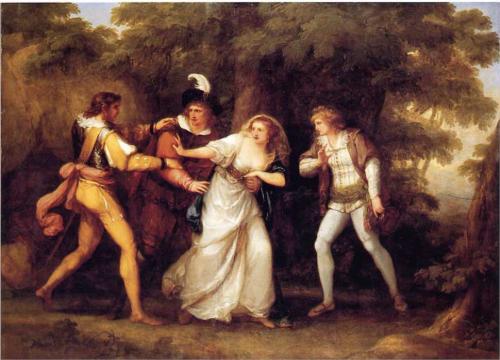
valentine-rescues-silvia-in-the-two-gentlemen-of-verona-1789
So, here are my musings on the first of the plays on my list. I’m interested to hear your reactions, too. I know a few of you have already jumped in and read the play. I’m coming to this having just seen Woody Allen’s latest, Blue Jasmine, this weekend with my family. I don’t know how that might affect my writing.

This isn’t an attempt at a definitive scholarly reading. I’m going to probe what I find enjoyable about Two Gentlemen of Verona and each play hereafter. But I’m not just talking about the “pleasure of the text” here. There is plenty of that: witty banter, funny situations, beautifully written poetry.

I’m also looking for the intellectual enjoyment that comes from my discovery of connections in and among the texts and the other readings I’m doing. And, finally, I suppose I’m looking for something deeper — the “spiritual enjoyment” that comes from experiencing great art. I’m look for moments that probe what it means to be human, that make you look at your life differently afterwards.

So, on to the play.

THE PLOT
The plot is simple and strange (I’ll talk about why I think that is later, when I talk about Proteus). Two young men of Verona, Valentine and Proteus, find themselves shipped off to Milan by their families. I’m guessing this is a Renaissance version of the grand tour? For Valentine, the trip proves to be a blessing. Seeking love, he finds it in the Duke of Milan’s daughter, Silvia. Unfortunately (of course), Silvia is promised to a wealthy buffoon named Thurio.

Meanwhile, Proteus’ trip to Milan is actually separating him from his love, Julia, who resides in Verona. But, fitting with his name, the changeable Proteus falls in love with Silvia on first site. He uses his relationship with the Duke to get Valentine banished from Milan so that he can be close to Silvia.

Unbeknownst to Proteus, Julia disguises herself as a boy and makes her way to Milan to be near her man. As these things happen in romantic comedies, she ends up becoming a page/messenger for her love, Proteus, and learns of his betrayal. She still acts as courier, though, agreeing to pass on Proteus’ love gift to Silvia. Horribly, the gift is actually the very ring which she, Julia, had given to Proteus on his departure from Verona.

Proteus is not a good guy.

When Silvia flees Milan to the forests outside in search of Valentine, she is captured by outlaws.

From here forward, coincidence and ridiculous changes of heart abound.

All of this unfolds in about 5 pages:

  • Proteus rescues Silvia.
  • Silvia refuses Proteus’ offers of love.
  • Proteus attempts to rape Silvia.
  • Valentine, who happens to have assumed the role of king of the outlaws, intervenes and declares Proteus dead to him.
  • Proteus apologies.
  • Valentine says, abruptly, that all is forgiven. You can have Silvia after all.
  • But then the “page boy,” Julia confesses she never delivered the ring to Silvia after all and gives it back to Proteus.
  • The ring she hands Proteus, however, is accidentally the ring that he had given her.
  • Seeing the ring, and then recognizing Julia (Finally! It’s not like she was wearing Clark Kent glasses), Proteus falls back in love with Julia.
  • Valentine, thus, is cleared to marry Sylvia, but for the Duke.
  • Except, when Thurio proves to be a coward when Valentine threatens him…
  • The Duke decides that Valentine is brave and worthy after all.
  • Marriages are implied to ensue.

MY TAKE
On its own, this play would not have made Shakespeare’s career. Being more direct, Harold Bloom calls it the “weakest of all Shakespeare’s comedies” (Invention, 36). But I definitely see many of the elements I most love in Shakespeare present in this play.

Banter, we have banter
First of all, there are the puns and witty banter. It is Shakespeare. That’s what is best here, as when Valentine and Proteus play with boots and shoes:

VALENTINE
That’s on some shallow story of deep love,
How young Leander crossed the Hellespont.

PROTEUS
That’s the deep story of a deeper love,
For he was more than over shoes in love.

VALENTINE
‘Tis true, for you are over boots in love,
And yet you never swum the Hellespont.

PROTEUS
Over the boots? Nay, give me not the boots.

VALENTINE
No, I will not, for it boots thee not.
(ACT 1.1 21-28)

Shortly after, Speed and Proteus engage in word play that seems the progenitor of a Noel Coward exchange:

SPEED
The shepherd seeks the sheep, and not the sheep the shepherd; but I seek my master, and my master seeks not me. Therefore I am not sheep.

PROTEUS
The sheep for fodder follow the shepherd; the shepherd for food follows not the sheep. Though for wages followest thy master; thy master for wages follows not thee. Therefore thou art a sheep.

SPEED
Such another proof will make me cry “baa.”
(ACT 1.1 86-93)

Send in the clowns
Shakespeare has his pairings of high and low characters, with Valentine and Proteus mirrored by Speed and Launce, their “men.” The clowns, as often happens in Shakespeare, win the day.

Launce stands out in the play as something more typical of later plays: his accidental comedy allows you to laugh at him while also sympathizing with him. Launce, Bloom and Garber both argue, is the most Shakespearean of all of the characters. I detected some whiffs of Falstaff in Launce. Launce’s soliloquy about his dog is worth citing here for its transcendence, in prose, of much of the rest of the play:

When a man’s servant shall play the cur with him, look you, it goes hard: one that I brought up of a puppy, one that I saved from drowning where three or four of his blind brothers and sisters went to it. I have taught him, even as one would say precisely, “Thus I would teach a dog.” I was sent to deliver him as a present to Mistress Silvia from my master, and I came no sooner into the dining chamber but he steps me to her trencher and steals her capon’s leg. O, ’tis a foul thing when a cur cannot keep himself in all companies! I would have, as one should say, one that takes upon him to be a dog indeed, to be, as it were, a dog at all things. If I had not had more wit than he, to take a fault upon me that he did, I think verily he had been hanged for’t. You shall judge. He thrusts me himself in to the company of three or four gentleman-like dogs under the duke’s table. He had not been there–bless the mark–a pissing-while but all the chamber smelt him. “Out with the dog,” says one. “What cur is that?” says another. “Whip him out,” says the third. “Hang him up,” says the duke. I, having been acquainted with the smell before, knew it was Crab, and goes me to the fellow that whips the dogs. “Friend,” quoth I, “you mean to whip the dog?” “Ay, marry, do I,” quoth he. “You do him the more wrong,” quoth I; “’twas I did the thing you wot of.” He makes me no more ado, but whips me out of the chamber. How many masters would do this for his servant?
(ACT IV 1-37)

The boy who is a girl who is a boy
Two Gentlemen of Verona launches Shakespeare’s cross-dressing. Dressed as a page boy, Julia creates wonderful moments of tension as she acts as the go-between for Silvia and Proteus. She talks of herself, as Julia the jilted lover, to each.

It’s all always so confusing and fun, knowing that all along the character “Julia” was played by a boy on the Elizabethan stage; so the “putting on” of the page boy outfit and demeanor would have actually meant, for the young actor, shedding the clothes and demeanor of the beautiful woman Julia is supposed to be.

I may be alone among the critics I’ve read in finding Julia to be and interesting and worthy Shakespeare heroine. Her plangent soliloquy in Act 4.4 is more human than almost anything else in the play, colored, I think, by the sympathy for her character that flows from Proteus’ treatment of her.

And I love the poetic despair that emerges in her dialogue with Silvia near the end. When Silvia asks Julia — thinking Julia is a messenger boy — if her rival, Julia, is “not passing fair?” Julia (in her page boy disguise) replies:

She hath been fairer, madam, than she is.
When she did think my master love her well,
She, in my judgment, was fair as you;
But since she did neglect her looking glass
And threw her sun-expelling mask away,
The air hath starved the roses in her cheeks
And pinched the lily-tincture of her face,
That now she is become as black as I.
(ACT IV.4 148-55)

What actress wouldn’t want to recite those lines?

The wrap up
So that’s the great and good in Two Gentlemen of Verona in my view.

But, as I noted above, the ending is a muddle — a rapid tying up of knots (even after Proteus’ attempted rape of Sylvia) that defies my modern ability to suspend disbelief.

Also, for a modern reader, the character of Proteus doesn’t read like a character at all. But I forgive Shakespeare Proteus when I think of Two Gentlemen of Verona‘s closeness in time to the Medieval mystery plays. Proteus is clearly a type, an allegory. He is named for a Greek god of the sea, a symbol for changeable nature. His names gives us the word “protean.”

With that Medieval sensibility in mind, I forgive the ending and the character of Proteus. In that light, I do end up seeing this play as “early” Shakespeare. It still carries the framework of its predecessors in the English drama.

But I have to admit I can’t help but read the play, as many have, as “foreshadowing” Shakespeare’s later greatness as he shed the past and forged a new drama for England.

I’ll leave it at that.

The Reading List: Month-by-Month

Surprisingly, determining precisely what to read among Shakespeare’s works is not a simple matter. Among the experts, he’s claimed to have written 37 or 39 plays. And when you add in the plays that were believe collaborations or that are caught up in authorship controversies of one sort or another, the numbers go even higher.

For my reading project, I’ve gone with Marjorie Garber’s list of 39 plays, and I’m following her reading order. This makes it convenient to read along, chapter by chapter, in her useful book, Shakespeare After All (2004). And she puts the Henry plays in order, which I like.

Garber favors the Norton edition of Shakespeare (the one based on the Oxford edition and edited by Stephen Greenblatt; as an aside, I’m eager to read his Will in the World (2004) this year, too). I’ve got the Oxford edition and will be using that. I also have a lovely set of the Pelican Shakespeare. Each play is individually hard bound, and they are just a pleasure to read; holding them in my hand, they feel like a book should feel. So I’ll be using those editions, too, when the conflict between quarto and folio isn’t a big issue (I’m realizing I should research and write another whole post on editions and publishing history now!).

I certainly expect it to change, but here, below, is my reading list mapped month to month. I’ve picked months where I know I have time off work to assign myself five plays. On months (like right now) when I’m busier at work, I’ve dropped to three plays.

You’ll notice at the end that I’ve left August to read the poetry. I imagine myself riding down to Ashland next summer while breezing through the Sonnets again. I hope to be there.

If all goes well, I’ll add some of the other, pseudo-Shakespeare in the mix.

    THE PLAYS

    September 2013

  • Two Gentlemen of Verona (1589-1591)
  • The Taming of the Shrew (1590-1594)
  • Titus Andronicus (1591–1592)

    October 2013

  • Henry VI, Part 1 (1591)
  • Henry VI, Part 2 (1590–1591)
  • Henry VI, Part 3 (1591)

    November 2013

  • Richard III (1592)
  • The Comedy of Errors (1594)
  • Love’s Labour’s Lost (1594–1595)
  • Romeo and Juliet (1595)

    December 2013

  • A Midsummer Night’s Dream (1595)
  • Richard II (1595)
  • King John (1596)
  • The Merchant of Venice (1596)
  • Henry IV, Part 1 (1596–1597)
  • Henry IV, Part 2 (1596–1597)

    January 2014

  • The Merry Wives of Windsor (1597–1598)
  • Much Ado About Nothing (1598–1599)
  • Henry V (1598–1599)

    February 2014

  • Julius Caesar(1599)
  • As You Like It (1599–1600)
  • Hamlet (1599–1601)

    March 2014

  • Twelfth Night (1601)
  • Troilus and Cressida (1602)
  • Measure for Measure (1603–1604)

    April 2014

  • Othello (1603–1604)
  • All’s Well That Ends Well (1606–1607)
  • Timon of Athens (1605–1606)

    May 2014

  • King Lear (1605–1606)
  • Macbeth (1606)
  • Antony and Cleopatra (1606)
  • Pericles (1607)

    June 2014

  • Coriolanus (1608)
  • The Winter’s Tale (1609–1610)
  • Cymbeline (1610–1611)
  • The Tempest (1610–1611)

    July 2014

  • Cardenio (1612–1613)
  • Henry VIII, or All is True (1613)
  • The Two Noble Kinsmen (1613)

    THE POEMS

    August 2014

  • Venus and Adonis
  • The Rape of Lucrece
  • A Lover’s Complaint
  • The Phoenix and the Turtle
  • The Sonnets (154)